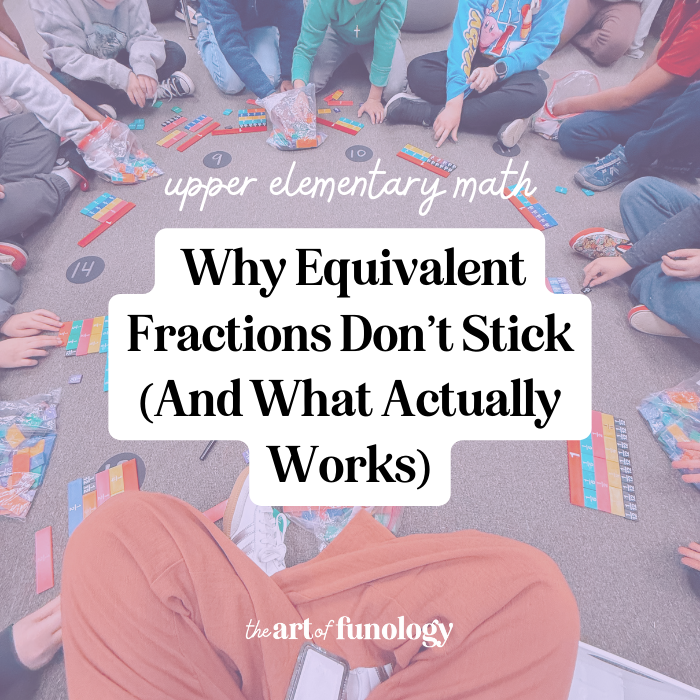
You’ve taught equivalent fractions six ways from Sunday. Anchor charts? Check. Number lines? Check. Digital games, paper cut-outs, even a YouTube rap? But how do you teach equivalent fractions conceptually?
But your students still look at you like you’ve just invented math.
Sound familiar?
If you’ve ever asked, “How do they still not see that 1/2 is the same as 2/4?” — you’re not alone. Upper elementary teachers everywhere hit this wall. And it’s not a sign you’re doing something wrong.
The real problem? Most fraction lessons start with numbers before students have a solid, visual understanding of what “equivalent” really means.
And without that conceptual foundation, equivalent fractions become just another set of rules to memorize — instead of something students understand.
Why Equivalent Fractions Feel Impossible to Teach
Let’s be honest: there’s nothing more frustrating than watching a student “solve” 3/4 = 6/8 just by doubling the numerator and denominator… and having no idea why it works.
Even worse? They think that’s the point of the lesson — to learn “the trick.”
That’s because most curriculum materials jump straight into numeric models. They hand students a worksheet or a Khan Academy video and say, “Just follow these steps.”
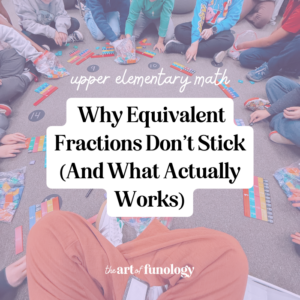
But when students can’t visualize fractions — when they’ve never built 1/2 and 2/4 with pattern blocks, or used fraction tiles to compare them side-by-side — the idea of equivalence has no meaning.
So what happens?
- They mix up denominators and numerators.
- They guess and check using multiplication or division “shortcuts.”
- They treat it like a logic puzzle instead of math with meaning.
- And when the numbers get more complex, they shut down — because there’s no understanding to fall back on.
Here’s the truth:
If students don’t first see and build equivalent fractions, they can’t understand them.
And when they don’t understand them, they can’t retain them. That’s why so many upper elementary teachers find themselves reteaching equivalent fractions over and over — especially in test prep season.
It’s not that your students can’t learn it. It’s that they’re being asked to skip a step they can’t afford to miss.
How to Teach Equivalent Fractions Conceptually (Before You Ever Touch a Worksheet)
If you’re figuring out how to teach equivalent fractions conceptually, the biggest shift is this:
students need to see equivalence before they ever calculate it.
Equivalent fractions are not a trick. They’re a relationship. And that relationship only sticks when students experience it with their hands, eyes, and brains working together.
This section walks through a concrete → visual → abstract progression that works especially well in upper elementary classrooms.
Step 1: Build the Idea of “Same Value” Before Naming It
Before introducing numbers like 1/2 or 2/4, students need repeated experiences with the idea that:
Different-looking parts can represent the same amount of a whole.
This is where hands-on materials matter most.
Using Pattern Blocks to Explore Fraction Equivalence
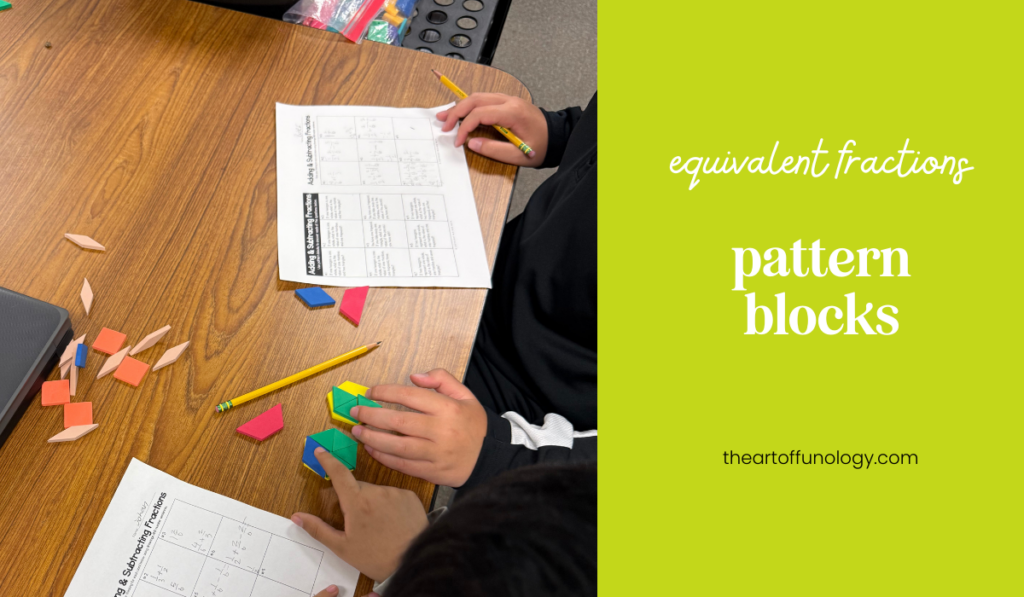
Pattern blocks are powerful because they remove numbers at first and let students focus purely on area and relationships.
Start with a hexagon as the “whole.”
Then ask students to cover it using other shapes.
What they’ll discover naturally:
- Two trapezoids cover the same area as one hexagon
- Three rhombuses also cover the same area
- Six triangles equal the same whole
Only after those discoveries do you attach fraction language:
- “If the hexagon is 1 whole, each trapezoid is 1/2”
- “That means 2/2 is equivalent to 1 whole”
- “Three rhombuses? That’s 3/3 — still the same value”
This visual foundation is critical for how to teach equivalent fractions conceptually, because students internalize that equivalence is about value, not appearance.
Step 2: Move to Fraction Tiles for Linear Equivalence
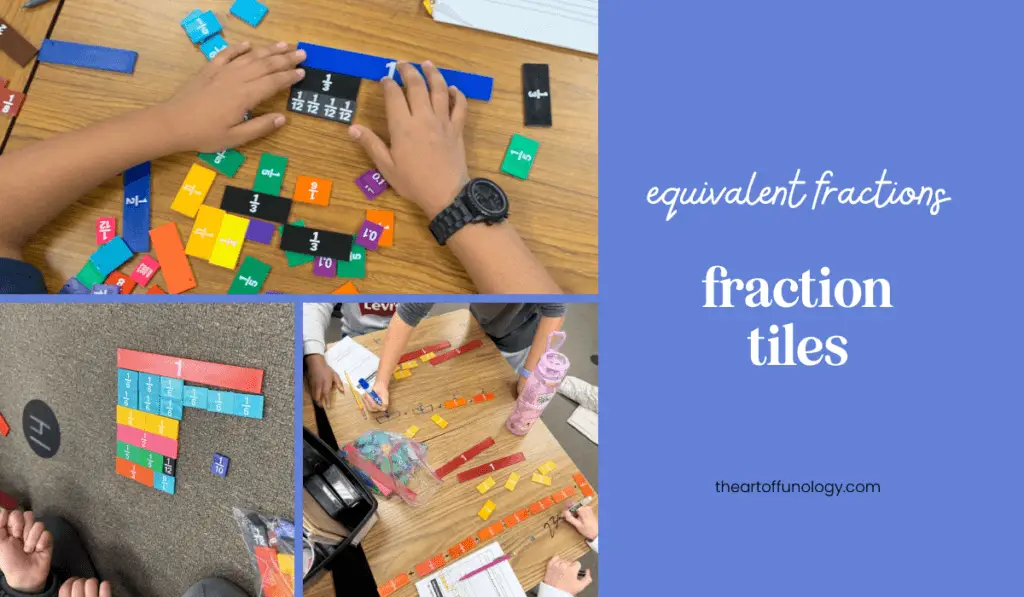
Once students understand equivalence through area, fraction tiles help them see it linearly.
Fraction tiles allow students to:
- Line up 1/2 and 2/4 side by side
- Stack 3/6 directly under 1/2
- Physically verify that the lengths match exactly
Instead of telling students “multiply the numerator and denominator,” you’re letting them prove equivalence with their hands.
Key teacher moves here:
- Always start with the same whole
- Align tiles carefully from the left edge
- Ask students what they notice before naming the equivalence
This builds a mental anchor:
Equivalent fractions take up the same space — even when the numbers change.
Step 3: Create Fraction Strips Students Can Keep
This is one of the most effective strategies for teaching equivalent fractions conceptually — and it costs nothing.
Have students make their own fraction strips using paper.
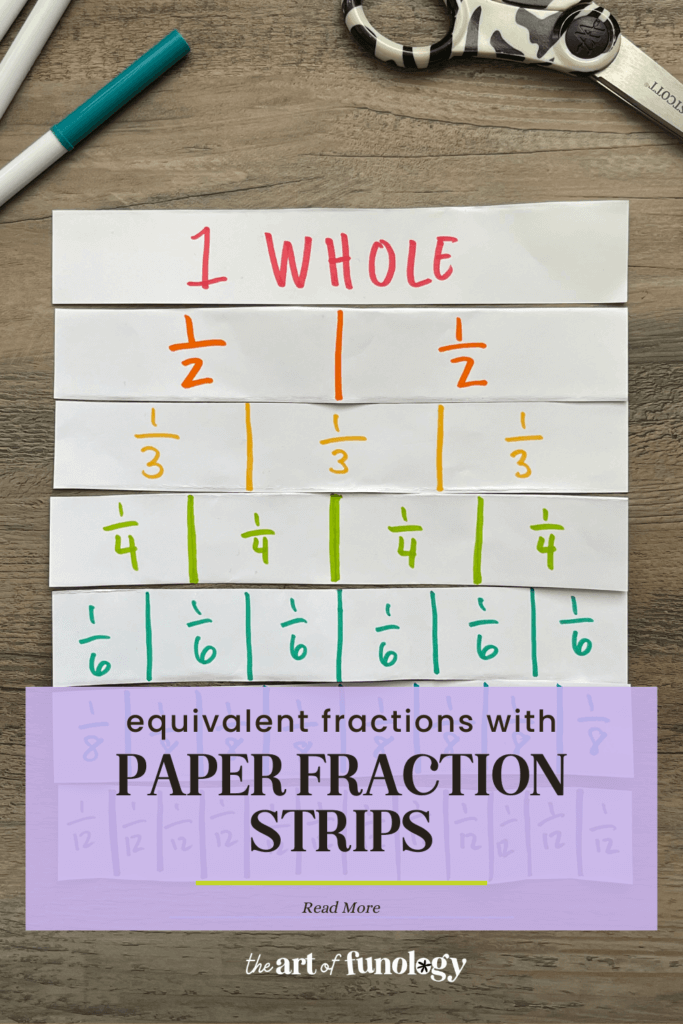
How it works:
- Start with a long strip labeled “1 whole”
- Fold another strip into halves, label each section
- Repeat with thirds, fourths, sixths, and eighths
- Stack and compare strips to find equivalences
Students will discover relationships like:
- 1/2 = 2/4 = 3/6
- 1/3 = 2/6
- 3/4 = 6/8
The magic here is that these strips become a reference tool.
Students can keep them in math folders, pencil boxes, or interactive notebooks and use them throughout the unit.
This is especially powerful for students who struggle with abstract fraction rules — they always have a concrete support to return to.
Want to see how I model this in the classroom? Watch the video tutorial here on Instagram.
Step 4: Name the Pattern (Only After Students See It)
Once students have repeatedly seen and verified equivalence, then — and only then — introduce the rule:
You can create an equivalent fraction by multiplying or dividing the numerator and denominator by the same number.
At this point, the rule makes sense because students already know:
- The value doesn’t change
- The size of the pieces does
The rule becomes an explanation, not a trick to memorize.
Step 5: Reinforce With Pixel Art (After Understanding Is Built)
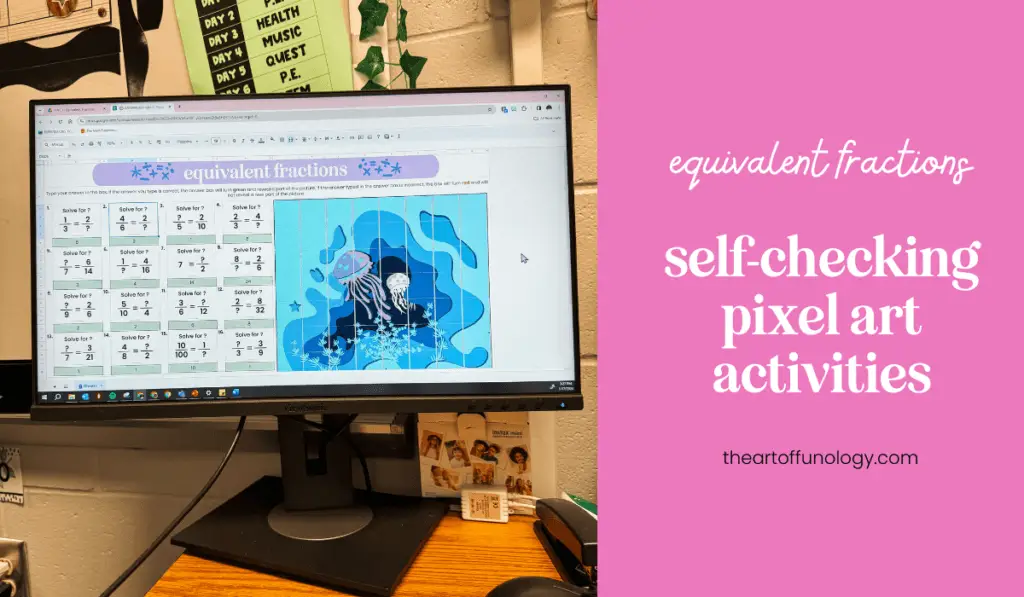
This is where pixel art fits — not as the introduction, but as intentional practice.
Pixel art works best when:
- Students already understand why fractions are equivalent
- The goal is fluency, confidence, and accuracy
- You want independent or small-group reinforcement
At this stage, pixel art:
- Reinforces equivalence visually
- Keeps practice engaging
- Prevents regression into guesswork
Once your students understand why 1/2 equals 2/4 or 3/6, they’re ready for fun, low-stress fluency work.
One of my favorite ways to reinforce math skills — without relying on worksheets — is through math pixel art. It’s self-checking, builds confidence, and keeps students engaged.
Grab a free pixel art math activity here to try it out!
Why This Approach Works for Upper Elementary Students
This sequence works because it:
- Honors how students actually learn fractions
- Reduces reliance on memorized procedures
- Supports visual and tactile learners
- Builds confidence before formal assessment
Most importantly, it answers the real question students are asking:
“Why are these fractions the same?”
And that’s the heart of how to teach equivalent fractions conceptually.
Why This Approach Works: Benefits of Teaching Equivalent Fractions Conceptually
When you’re figuring out how to teach equivalent fractions conceptually, your goal isn’t just to check off a standard—it’s to help students understand what equivalence actually means. That takes more than tricks or shortcuts. It takes strategy, structure, and visuals.
Here’s why this method works—both for you and your students:
Students see the math before they compute it
When students explore with pattern blocks, fraction strips, and fraction tiles, they develop a visual sense of what “equivalent” actually looks like. They can see that 1/2 and 2/4 cover the same space long before they multiply denominators.
This builds a conceptual foundation they can return to when they get stuck—especially for students who struggle with abstract number reasoning.
Pixel Art Keeps Practice Fresh
After the hands-on phase, pixel art gives students a fun, tech-friendly way to practice identifying and generating equivalent fractions. The immediate feedback and visual reward help maintain focus during independent work, especially for students who typically disengage from worksheet-based review.
This makes it easier to sustain engagement during fraction units that often drag.
Hands-On + Digital = Differentiation Done Right
Combining concrete tools (like paper folding, manipulatives, or visuals) with digital reinforcement (like pixel art) meets the needs of a wider range of learners—especially in upper elementary classrooms where students are all over the map.
This mix gives you flexibility:
- Pull a small group for tiles/strips
- Let others work independently on pixel art
- Know everyone is still thinking about why the fractions are equal
You Get Real-Time Data on Fluency & Misconceptions
Pixel art gives you built-in insight: one look at the picture reveals where students are making mistakes. If the art looks off, it’s a red flag. If a student keeps entering 1/2 and 3/6 as different, you know they haven’t internalized the equivalence.
This makes it easy to spot patterns, reteach quickly, and give meaningful feedback.
Ready to Try It? Start with a Free Pixel Art Activity
If you’re curious about how this all comes together—or you want to test the waters before diving into a full product—start with a free pixel art activity!
It’s a low-prep, high-engagement way to give your students independent practice with fractions (and give you a peek at how this style of math review works in your room).
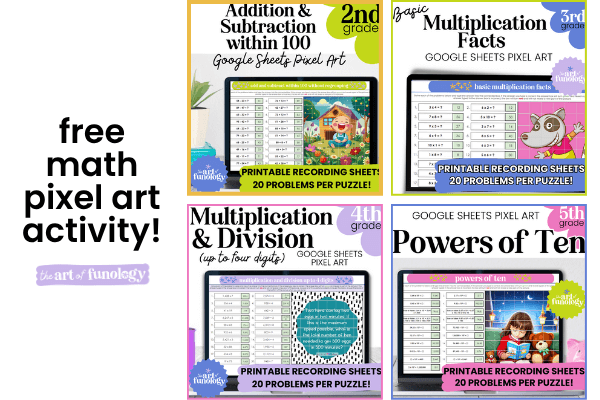
Grab the free pixel art activity here
Perfect for 3rd–5th grade students building fluency and fraction flexibility.
Want more ready-to-use fraction pixel art?
If you’re loving the idea and want more pixel art to support your upper elementary fractions unit, check out my full bundle of fraction pixel art activities on TpT. It’s great for review, centers, and even sub plans during your fractions unit.
Browse Fraction Pixel Art resources here
Teaching Equivalent Fractions Conceptually Doesn’t Have to Be Complicated
If your students are struggling with equivalent fractions, it doesn’t mean you’ve done something wrong—it usually means they haven’t had enough conceptual exposure to what equivalence actually means.
By leading with hands-on tools like paper strips, pattern blocks, and fraction tiles, you give them a foundation that clicks. You’re not just throwing rules at them—you’re helping them see the relationships.
Once they’ve built those visual connections, tech-based tools like fraction pixel art can take the baton and reinforce their understanding in a way that’s fun, familiar, and low-prep.
💡 Whether it’s their first time seeing ½ = 2/4 or their tenth time reviewing it, a concept-first approach changes everything.
If you want more support teaching fractions in upper elementary, don’t forget to grab the free Pixel Art resource below—it’s a great way to make independent practice feel more like a game than a grind.
You’ve got this—and your students do too.
Looking for more math support? You might also like:
- How to Set Up a Math Block that Works
- 5 Ways to Use Pixel Art in your Math Block
- Why I Quit Doing Math Centers