If you’ve ever wondered how to teach decimals conceptually in 5th grade without completely derailing your schedule, you’re not alone. The good news? You don’t need an overhaul. You just need a few anchor strategies that build true understanding—and still keep things moving.
Decimals tend to show up just when everyone’s patience is running low.
It’s test-prep season, the pacing guide is packed, and students are already juggling fractions, geometry, and volume. So when decimals enter the mix, it’s tempting to teach the algorithm, assign a worksheet, and move on.
But if students don’t understand what’s happening behind the decimal point, the algorithm becomes just another trick they memorize—and forget.
In this post, you’ll learn three classroom-tested strategies to make decimal instruction stick, even in a busy upper elementary classroom.
Want a low-prep way to boost math engagement across topics?
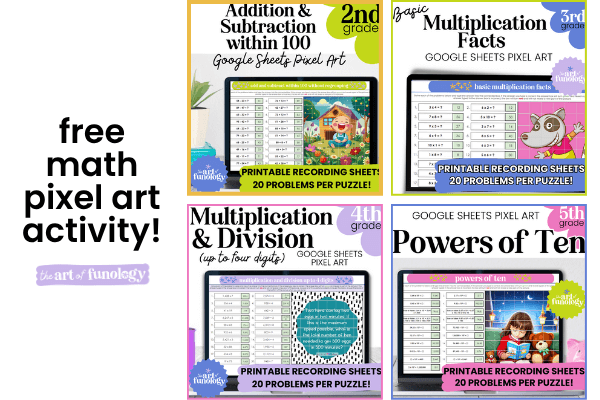 Grab a free sample Pixel Art activity your students can try this week.
👉 Get it here
Why Students Struggle With Decimals in 5th Grade
(And Why It’s Not Their Fault)
If you’ve ever wondered how to teach decimals conceptually in 5th grade—this is why:
Most students struggle with decimal operations not because they’re careless, but because they never developed a solid understanding of decimal place value.
You’ve probably seen it in action:
- A student adds 3.4 and 0.08 by stacking the digits from the right (like whole numbers).
- Another subtracts 4.07 from 7 and places the decimal “wherever it looks right.”
- A third one adds 0.5 and 0.25 and confidently writes down 0.75… but can’t explain why it works.
These aren’t silly mistakes or signs of laziness. They’re symptoms of skipped conceptual understanding.
When decimal instruction jumps straight to steps and shortcuts, students focus on digit-counting rather than value. They start relying on rules like “line up the decimals” without ever grasping why the decimals matter or how they represent parts of a whole.
And it’s not just about test prep. This fragile understanding leads to deeper issues later on—fractions, percentages, and ratios all depend on a strong foundation in place value decimals.
The truth is: upper elementary students are absolutely capable of mastering decimals, but they need more than procedures.
They need meaning.
Let’s look at how to give them that.
Concrete to Conceptual: How to Teach Decimals Conceptually in 5th Grade
To avoid the common spiral of decimal confusion, I always start with hands-on and visual models before ever touching an algorithm. Teaching decimals conceptually in 5th grade isn’t just about knowing what to do—it’s about understanding why it works.
Here’s how I build that foundation, one layer at a time:
1. Base-Ten Blocks & Grids: Build Visual Understanding
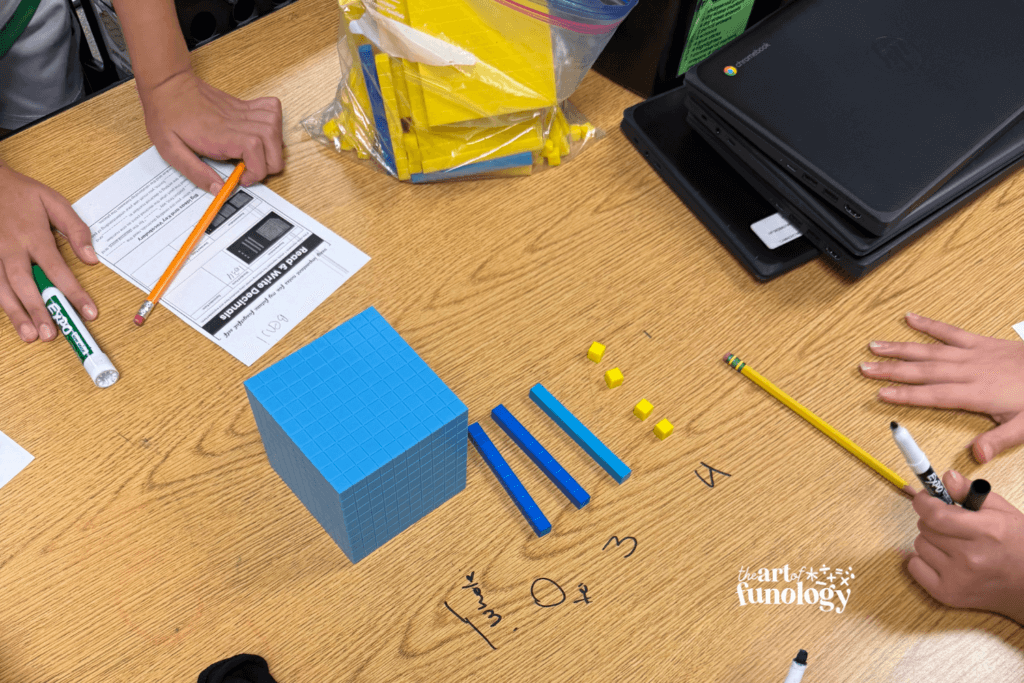
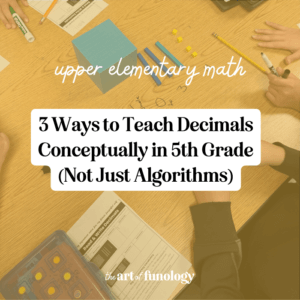
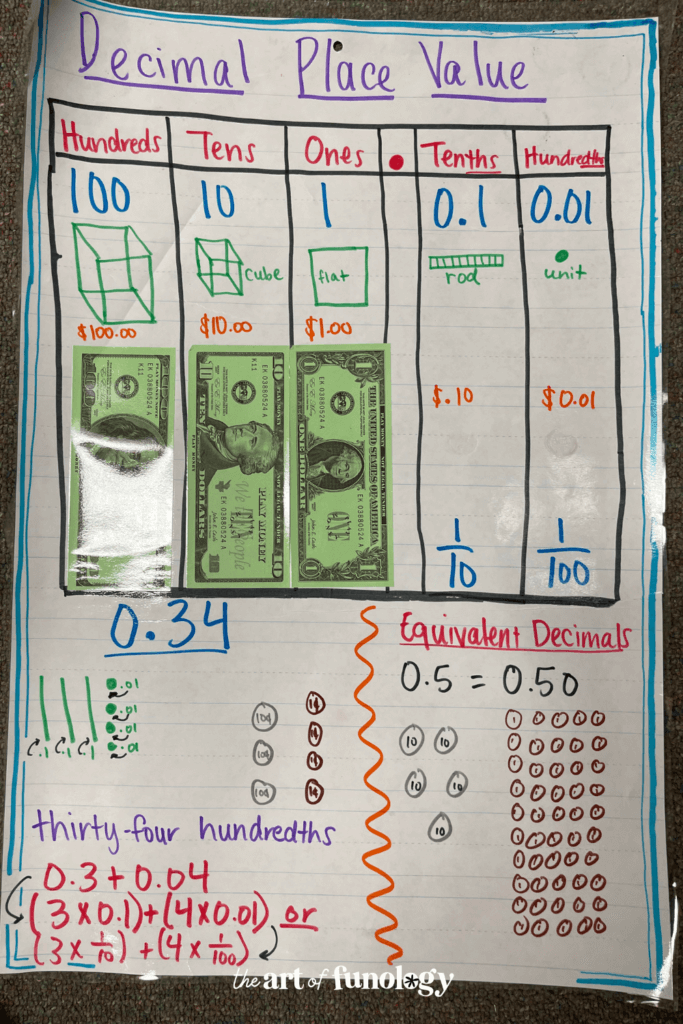
We begin with base-ten blocks and decimal grids to physically represent place value. Students can see that ten tenths make a whole, or that one hundredths square is literally a sliver of the full unit.
This stage is crucial for:
- Understanding decimal place value visually
- Connecting fractions to decimals
- Recognizing the relative size of tenths vs. hundredths
Students model problems like 0.3 + 0.4 using tenths rods and hundredths squares to truly grasp how values combine or break apart.
2. Place Value Discs: Bridge Visuals and Computation
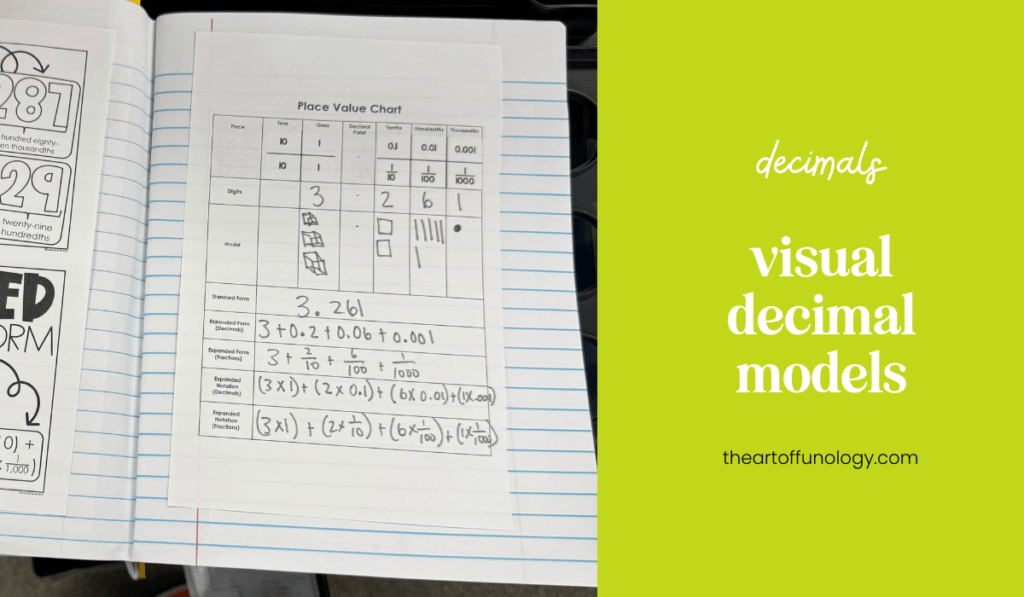
Once students are confident with blocks, we move to place value discs to prepare for computation. These color-coded discs are labeled 1, 0.1, and 0.01—giving students a clean, clear model that feels closer to the algorithm.
Using place value mats, students practice:
- Composing and decomposing decimals (e.g., trading 10 tenths for 1 whole)
- Regrouping during subtraction (e.g., changing 1 tenth into 10 hundredths)
- Aligning values by place, not by digit length
This tool is especially helpful for avoiding common decimal misconceptions, like adding tenths to hundredths or stacking digits incorrectly.
3. Number Lines & Money: Make Real-World Connections
Next, I bring in number lines and money to help bridge models to meaning.
- Number lines help students visualize decimals in sequence and compare their size
- Money reinforces base-ten logic with values they already understand (e.g., $1.00 = 10 dimes)
When a student can place 0.75 correctly on a number line and relate it to 3 quarters, you know the concept is sticking.
4. Discussion & Estimation: Build Strategic Thinking
Throughout these models, we constantly pause for:
- Estimation checks (“Does 0.3 + 0.6 make sense as 0.09?”)
- Number talks (“Which is greater: 0.4 or 0.04—and how do you know?”)
- Discussion routines that prompt students to explain their reasoning
These routines deepen understanding and boost math reasoning—especially for students who typically memorize without connecting.
THEN: Reinforce with Pixel Art Practice
Once students have a solid grasp on decimal place value and conceptual models, it’s time to reinforce with meaningful, low-stress practice.
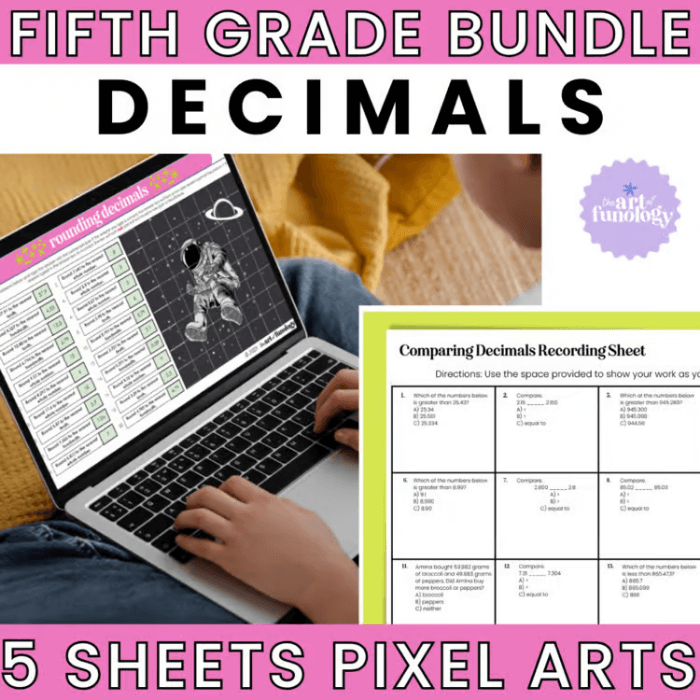
That’s where my Decimal Pixel Art Bundle comes in! Each activity is:
- Standards-aligned
- Auto-graded in Google Sheets
- Visually rewarding (the picture only appears with correct answers)
- Designed for independent fluency, not surface-level recall
Pro tip: Don’t lead with pixel art. Use it as a follow-up to deepen accuracy and confidence after conceptual teaching.
Why Teaching Decimals Conceptually in 5th grade Pays Off (and How Pixel Art Helps)
Teaching decimals conceptually in 5th grade isn’t just about covering the standards—it’s about helping students build number sense that lasts beyond test season. And once you’ve laid that foundation, the right kind of follow-up practice can make all the difference.
Here’s how the Decimal Pixel Art Bundle supports student learning and saves your sanity.
-
Targeted Practice That Reinforces Real Understanding
Once students have explored decimals with base-ten blocks, number lines, and hands-on models, they need time to solidify what they’ve learned. But worksheets can feel like busywork—and often don’t show you what students really understand.
Pixel art gives them meaningful, standards-aligned problems to solve, with a built-in motivation to do their best. Every correct answer reveals part of a mystery image, keeping students engaged and focused without the need for extra incentives.
- Low-Stress Format That Builds Confidence
You know those kids who shut down as soon as they see a dense page of decimal problems? Pixel art lowers the affective filter. The work is rigorous, but it doesn’t feel like a test or drill.
By presenting questions one at a time and offering immediate feedback through the image, students feel safe to try, revise, and keep going—without the fear of public mistakes.
This is especially powerful when you’re reteaching or reviewing decimal concepts before a test. Students get to practice skills like:
- Comparing decimals
- Adding and subtracting decimals
- Rounding decimals to the nearest tenth or hundredth
…in a format that feels like fun, not failure.
-
Versatile Use Across Your Math Block
Because it’s no-prep and self-checking, this resource fits easily into different parts of your week:
- Independent work during your math block
- Small group rotations or centers
- Fast finisher extension
- Emergency sub plans
- Targeted spiral review during test prep
You’re not tied to direct instruction or constant grading. The activity does the work with you.
-
Self-Checking = Time Back for You
Every pixel art activity in the bundle is Google Sheets-based, which means students get instant feedback. That’s right—no checking stacks of practice pages or trying to decipher what went wrong.
You get real-time insight into who’s understanding decimal place value and who might need a reteach—without hovering at every desk or grading after school.
That’s not just smart teaching—it’s sustainable teaching.
What Teachers Are Saying
“This was just the activity I was looking for to keep my students engaged during our differentiated math time. It is a great activity for centers or menus.”
— Elizabeth G.“My students love mystery pictures. This one did not disappoint. Review of skills, fun activity, instant feedback.”
— Heather C.“My students love pixel arts! Was very nice having it checked for them. Students seemed to enjoy seeing the picture at the very end.”
— Lindsay S.
Put It Into Practice
Want all your decimal practice in one place?
The Decimal Pixel Art Bundle covers the key concepts your students need:
- Place Value
- Comparing & Ordering
- Adding & Subtracting
- Word Problems
Grab the Decimal Pixel Art Bundle HERE!
Want more options?
Explore all my decimal resources and activities here
Want to Test It Out First?
Try a FREE sample pixel art activity your students can use right away:
Teach Decimals Conceptually in 5th grade for Real Understanding
Teaching decimals conceptually in 5th grade doesn’t have to be complicated—but it does have to be intentional.
Start with visuals. Use hands-on models like base-ten blocks, paper strips, and number lines. Make space for discussion and estimation. Then, when students are ready, give them pixel art practice that actually reinforces what they’ve learned.
When your students understand the why, the computation sticks longer—and the stress melts away.
You’re not just teaching decimal skills.
You’re building decimal sense.
Keep Going: More Posts You’ll Love
If this post was helpful, you might also enjoy:
- How to Teach Measurement Conversions in Upper Elementary
- 5 Ways to Use Pixel Art in Your Math Block
- Teaching the Thinking Behind Multi-Step Word Problems (Without Keywords)