Let’s Build a Math Block That Works—for You and Your Students
Setting up a math block can feel overwhelming—especially if you’re departmentalized or balancing multiple groups. But here’s the truth: your math block doesn’t have to be perfect on Day 1. In this post, we’ll break down how to set up a math block that’s flexible, effective, and easy to launch no matter your schedule.
You’ll find real examples for 60, 75, and 90-minute blocks, plus ideas for building your routines gradually without burning out. This post is full of ready-to-use strategies that will help you walk in with a plan and walk out with a classroom that runs like a dream.
1. What Is a Math Block and Why It Matters
Your math block is the time you spend teaching math each day—but it’s more than a time slot. It’s the structure that gives your students consistency and gives you confidence. When your math block flows well, everything from engagement to behavior improves.
A strong math block is made up of intentional, repeatable parts: warm-ups, mini lessons, student practice, small groups, and reflection. These elements work together to build deep math understanding, support diverse learners, and help you monitor progress without scrambling every afternoon.
The best blocks weave together:
- Warm-ups and fluency routines
- Whole-group instruction or task launches
- Student work time (independent, collaborative, or centers)
- Reflection and discussion
- Small group support (if time allows)
How you combine these depends on your available time. Here’s a quick breakdown:
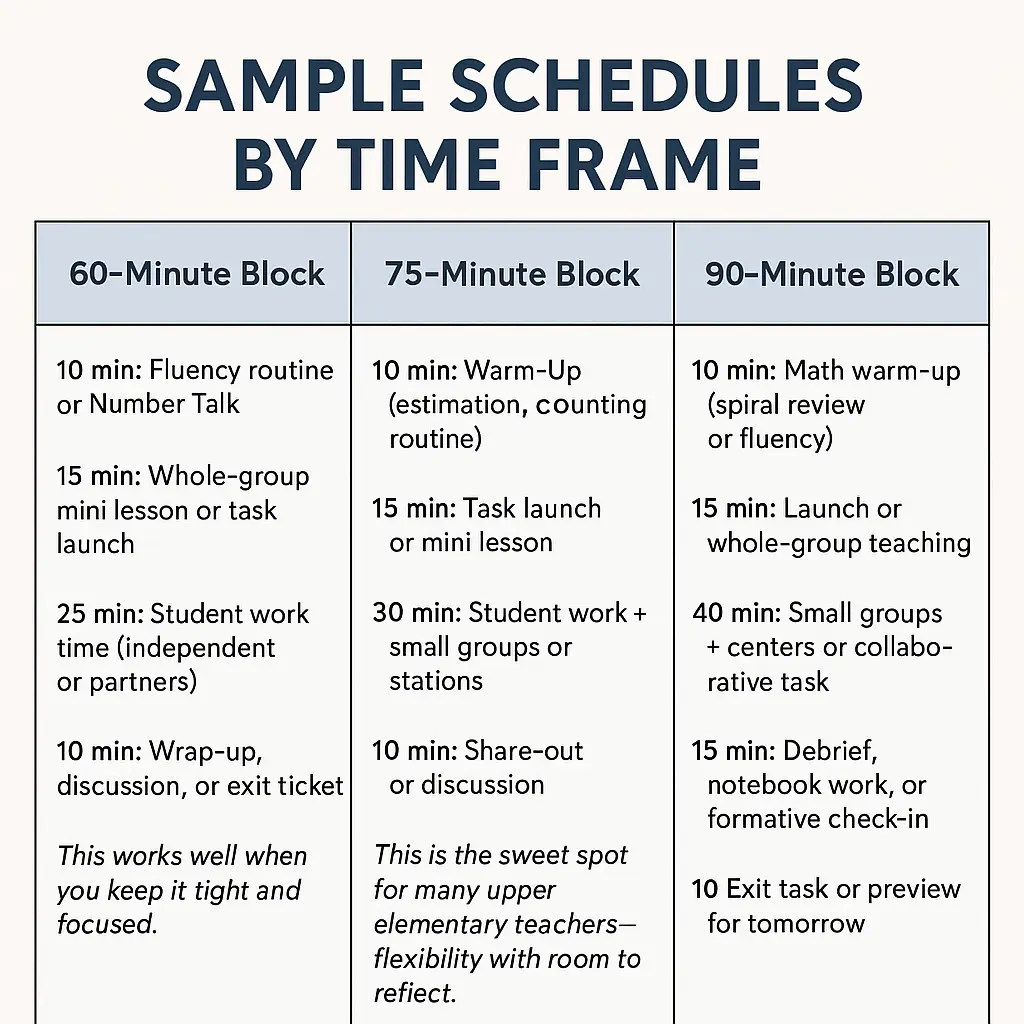
Sample Schedules by Time Frame:
60-Minute Block
- 10 min: Fluency routine or Number Talk
- 15 min: Whole-group mini lesson or task launch
- 25 min: Student work time (independent or partners)
- 10 min: Wrap-up, discussion, or exit ticket
This works well when you keep it tight and focused.
75-Minute Block
- 10 min: Warm-Up (estimation, counting routine)
- 15 min: Task launch or mini lesson
- 30 min: Student work + small groups or stations
- 10 min: Share-out or discussion
- 10 min: Journal reflection, math menu, or extension task
This is the sweet spot for many upper elementary teachers—flexibility with room to reflect.
90-Minute Block
- 10 min: Math warm-up (spiral review or fluency)
- 15 min: Launch or whole-group teaching
- 40 min: Small groups + centers or collaborative task
- 15 min: Debrief, notebook work, or formative check-in
- 10 min: Exit task or preview for tomorrow
With 90 minutes, you can dive deep. Just remember to pace it well so students aren’t sitting too long without movement or variety.
2. How to Set Up a Math Block That Matches Your Teaching Style
There’s no one-size-fits-all model. You get to choose a math block structure that works for you—and that might shift throughout the year. The goal is to match your teaching style, student needs, and curriculum pacing without losing your mind in the process.
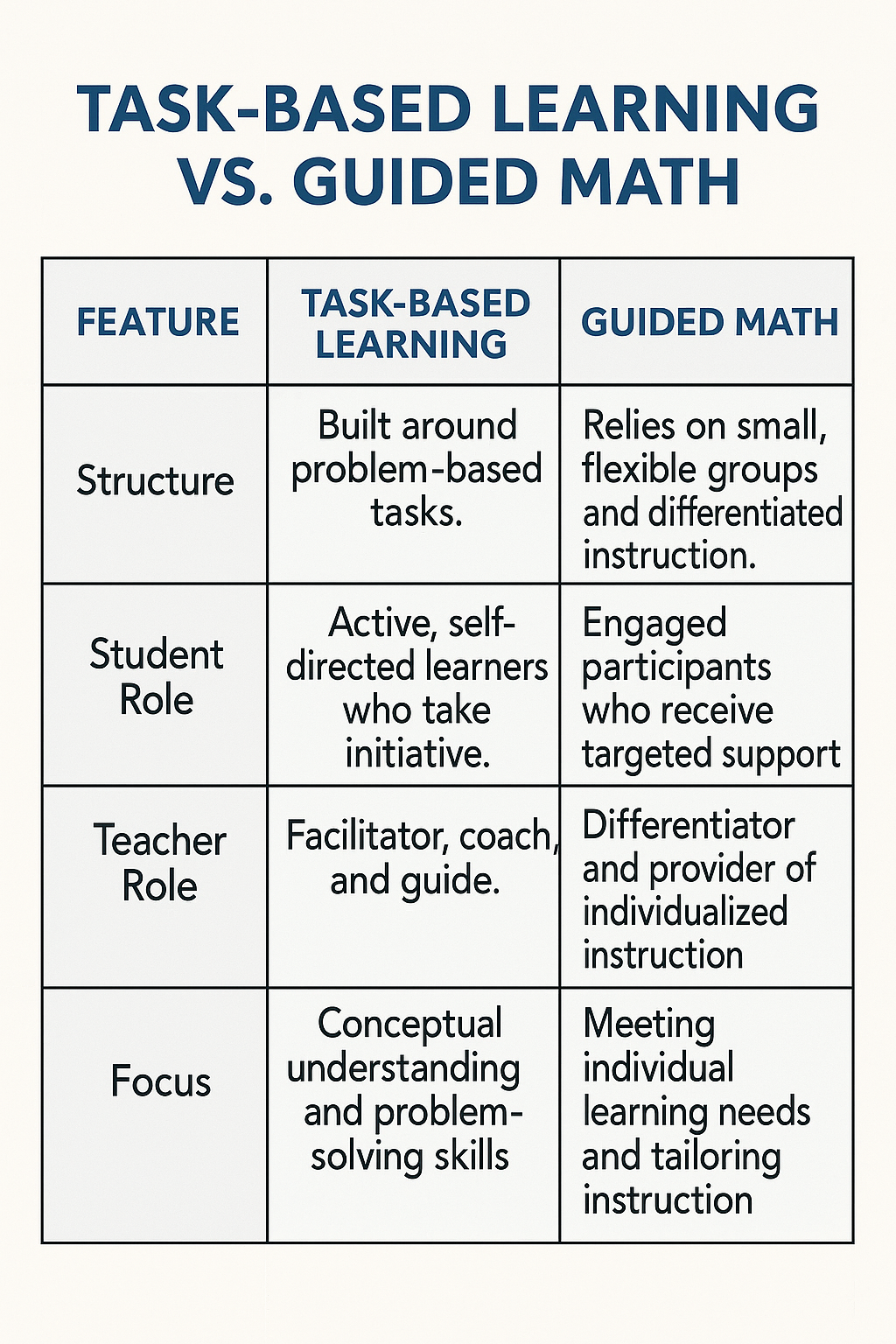
Task-Based Learning Model
This model focuses on collaborative problem solving and critical thinking. Students work in groups (often at vertical whiteboards) and share their strategies with the class. It’s messy, beautiful, and full of energy.
Example (75 Minutes):
- 10 min: Warm-Up or Estimation Routine
- 25 min: Task (students work in pairs/small groups)
- 15 min: Share-Out + Strategy Discussion
- 15 min: Math journal, sketch note, or reflection
- 10 min: Exit task or cleanup
This is great for teachers who want to prioritize math discussion, multiple strategies, and student agency. It pairs well with visible thinking and productive struggle.
Balanced Numeracy Model
This model gives structure and routine to your day while offering flexibility. It combines everything from mini lessons and centers to teacher-led small groups and math menus.
Example (60 or 90 Minutes):
- Mini lesson (10–15 min)
- Student rotations: teacher table, center, independent work (45–50 min)
- Whole-class share or wrap-up (10 min)
- Exit task or math journaling (optional add-on)
This works well when you have a wide range of learners and want the chance to differentiate regularly. It’s also great for teachers who like clearly defined chunks of time.
*Tip: You can rotate models! Task-based on problem-solving days, numeracy on skill-focused ones.
3. Anchor Your Block with Visuals and Targets
Setting up a math block also means making your routines visible for students. When kids can see the flow, refer to anchor charts, and track learning targets, your classroom starts to run itself.
Here are tools that make your block run smoother:
- Daily Learning Targets: Use student-friendly I Can statements. (A week’s worth is in the Starter Kit!) They help students focus and give you a quick way to check for understanding.
- Math Block Visual Schedule: Label each block component—great for students who thrive on structure. Use Velcro icons or a printed schedule that lives on the board.
- Math Tools + Anchor Charts: Anchor charts should be co-created and posted as reference. Tools like number lines, fraction strips, and base ten blocks should be visible and accessible.
Visual supports promote independence, reinforce routines, and reduce repeated questions like “What are we doing now?”

4. Small Group Time Doesn’t Need to Be Complicated
One of the biggest myths about setting up a math block? That you have to meet with every group, every day. Nope. Small group instruction is about consistency—not quantity.
Start simple:
- Meet with 1–2 groups per day
- Use formative data or simple observations to group students
- Track notes using sticky notes, a clipboard, or a simple Google Form
When planning small group lessons, keep them short and focused. Use quick warm-ups, a single strategy reteach, or a short problem-solving session. You don’t need to reinvent the wheel.
You can:
- Pull a reteach group based on yesterday’s exit ticket
- Meet with enrichment groups while others work independently
- Use games, flashcards, or whiteboards for quick checks
**Pro Tip: The Starter Kit’s Math Block Planning Template can help you sketch this out.
5. Build Your Block One Day at a Time
You don’t need to launch everything in week one. In fact, I recommend the opposite: roll it out slowly using a “First Ten Days of Math Block” approach.
Routines take time to establish, and jumping in too fast often leads to frustration. Instead, give yourself space to teach how you want math to look, sound, and feel. You’re not just teaching math—you’re teaching how to do math in your classroom.
Here’s what that might look like:
Day 1–2: Establish math community, norms, and expectations
Day 3–4: Introduce warm-ups, notebook routines, and math tools
Day 5–6: Add a mini lesson + practice block
Day 7–8: Model transitions and simple centers
Day 9–10: Try a full schedule with reflection and share-out
Use this gradual approach to build student independence and give yourself time to refine what works. Keep anchor charts posted for every new routine you introduce and review them often. By the end of the second week, you’ll be amazed at what your class can handle.

What’s Your Go-To Math Block Tip?
Let’s crowdsource some wisdom! What’s one thing that helped you finally feel good about your math block? Leave a comment or DM me on Instagram @theartoffunology.
Grab Your Free Math Block Setup Tools
Want ready-to-use templates and printables to build your math block? Grab the free Back-to-School Starter Kit—it includes:
- A Math Block Planning Template
- One Week of Printable Learning Targets
- Visual Schedule Icons + Editable Class Jobs Sample
Download the Free Starter Kit Here