
Kick Off the Year with Purpose
Want to build math confidence from day one—but also make students feel like they belong? These back to school math activities do both.
As teachers, we spend hours prepping lessons, labeling supplies, and hanging up bulletin boards. But when that first bell rings, what matters most is the classroom culture we create. Especially in math—where confidence can make or break participation—it’s essential to build connection, trust, and curiosity from the start.
Here are my favorite ways to start the year with back to school math activities that build a strong classroom community and lay the groundwork for mathematical thinking, identity, and productive struggle.
1. Start with Math Identity: A Back to School Math Activity
Before the math content begins, students carry beliefs about themselves as mathematicians. Some are excited. Others are nervous. Many are unsure. That’s why one of the first things I do in the math block is create space to explore and affirm students’ math identities.
One simple tool I love is a Math Identity Survey. It includes questions like:
- What are your strengths as a math learner?
- What makes you feel stuck?
- What’s something you want to get better at this year?
- How do you feel when it’s time for math?
Pair the survey with warm-ups or journal entries:
- When do you feel confident in math?
- What makes a great mathematician?
- What do you hope math will feel like this year?
You can also have students complete a math-themed “All About Me” page or collaborate on a class poster titled “We Are Mathematicians” where everyone contributes a word or phrase. These early identity-building activities are inspired by ideas from Productive Math Struggle—they send the message that math is more than just numbers. It’s thinking, effort, voice, and identity.

2. Build Teamwork with Low-Stakes Back to School Math Challenges
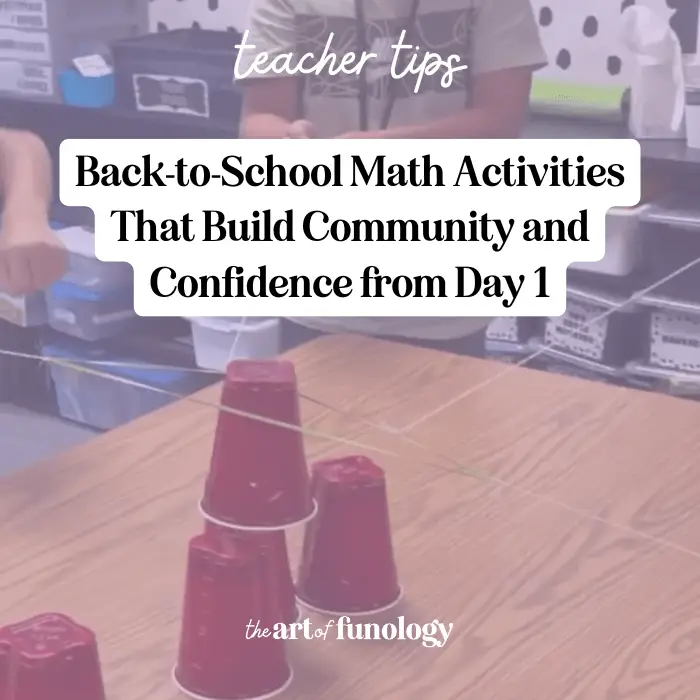
Nothing says classroom community like a group of students laughing while building a tower of cups—with only a rubber band and string. That’s one of my go-to back to school math activities for the first day of math: the rubber band cup stacking challenge.

Students work in small groups to stack plastic cups into a pyramid using only a rubber band contraption they manipulate together. It’s a lesson in teamwork, strategy, and communication—and it leads beautifully into deeper conversations about how we work together in math.
You can also rotate in partner dice games, math fact races, or collaborative problem-solving tasks. I love using Visibly Random Grouping Cards to create diverse teams each day (available separately in my TPT store). Each day, students are grouped in a new, fun way (by colors, categories, themes)—making collaboration feel like a game in itself.

3. Teach Routines Through Back to School Math Content
We’ve all been there: the rule slides, the procedures, the “don’t do this” and “definitely do this” monologue that lasts… forever. Here’s what changed the game for me: embedding routines inside math content.
We practice transitions using fun back to school math activities that double as routine-building tools. Instead of saying, “This is what you do when you’re done,” I show them with math. We do a low-pressure math warm-up together, and then I introduce an early finisher station using a pixel art activity or puzzle that’s already prepped. This allows me to still start strong while not getting too far behind with pacing.
When it comes to expectations, I love to act them out with my students. We model both the correct and incorrect way. I get dramatic. I let students play along, and they always love it! It’s fun, it’s memorable, and it keeps us laughing while learning.
4. Center Student Voice with Math Norms and Posters
Letting students co-create your classroom expectations isn’t just good practice—it builds ownership. One of my favorite early-week activities is working with my class to create anchor charts like:
- “Our Math Class Promises” – phrases like “We try before we ask,” or “We celebrate mistakes.”
- “What Mathematicians Do” – ideas such as “Ask questions,” “Work with others,” “Use different strategies”
- “Strategies We Use When We’re Stuck” – such as “Draw a model,” “Use a manipulative,” “Look at the anchor chart”
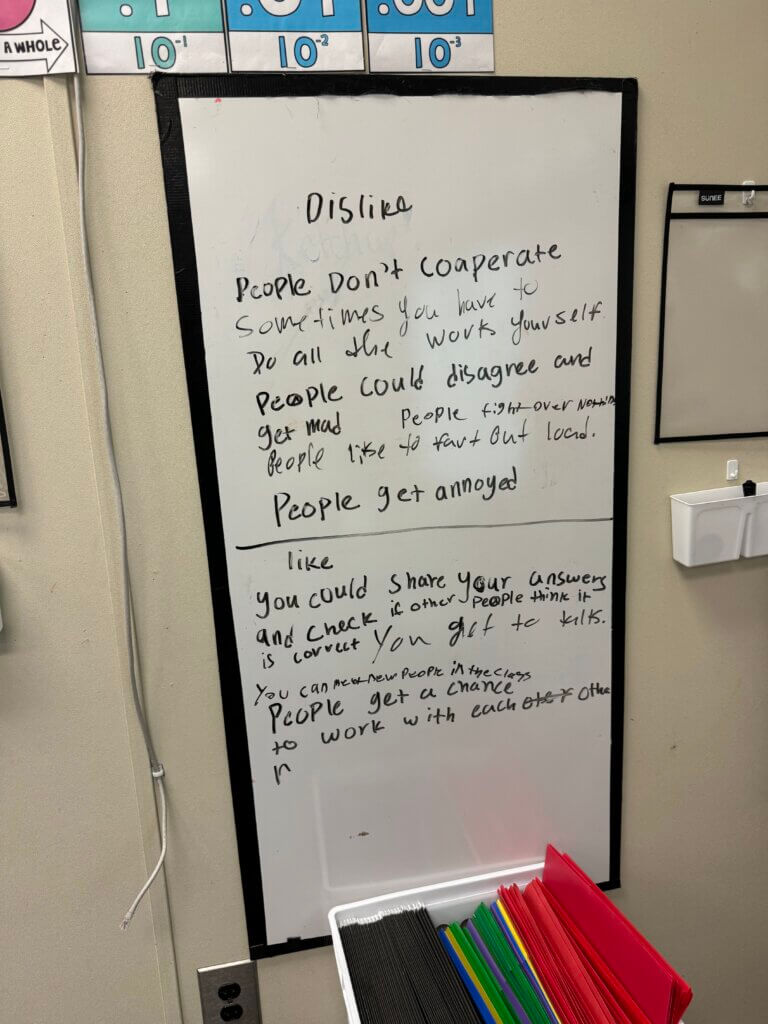
These posters become reference points all year long. You can also invite students to participate in gallery walks where they leave sticky note responses to prompts like, “How can we make this class feel safe for mistakes?” or “How do we help each other in math?” After reviewing their sticky notes together, we can use them to modify our class pledge and expectations that we have created together.
These early routines establish that everyone has ideas worth sharing and help quieter students feel heard from the start.

5. Begin with Open-Ended Back to School Math Activities
Some of my favorite back to school math activities don’t look like traditional math at all…
You don’t need to dive into the textbook on Day 1. In fact, some of my favorite beginning-of-year back-to-school math activities don’t look like traditional math at all. One of my go-to’s is the “Cows and Chickens” problem—a low-floor, high-ceiling task that invites students to explore number combinations with animals and legs. Another favorite is “How Many Squares?”, which gets students talking, estimating, and revising their thinking.
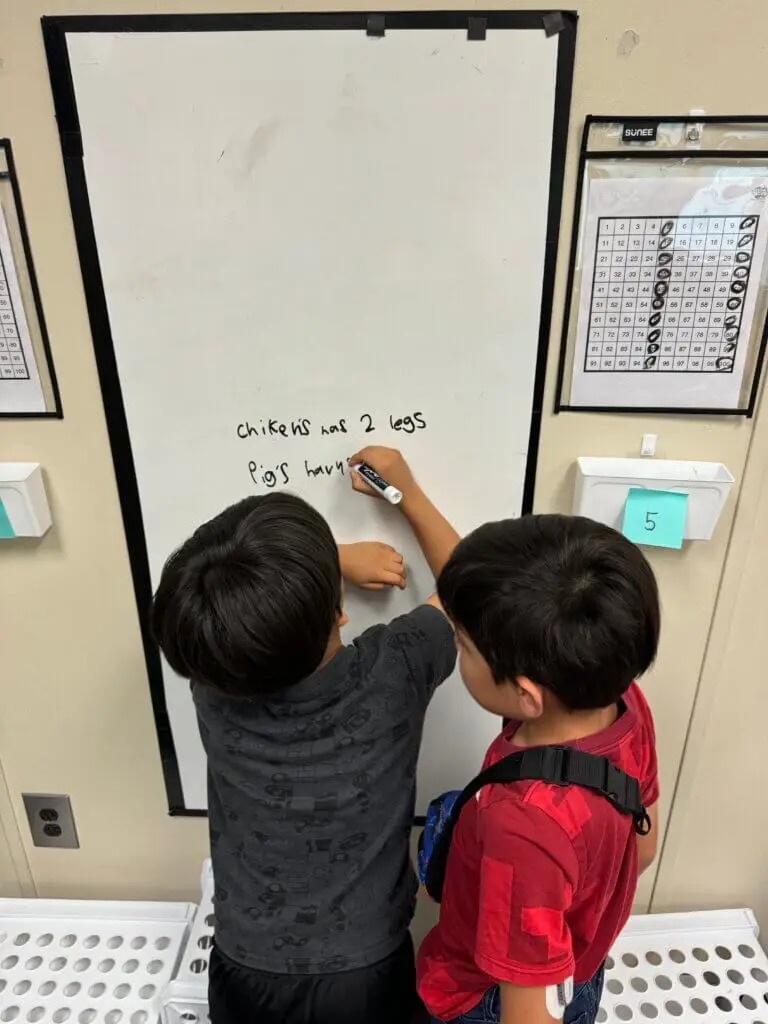
These tasks build curiosity, encourage productive struggle, and create a safe space for trying things without the fear of being “wrong.” They’re also perfect for launching Thinking Classrooms and helping students get comfortable working in vertical teams or pairs.
🔗 Cows and Chickens Task (nrich.maths.org)
🔗 How Many Squares? Visual Task (YouCubed)
Normalize Productive Struggle Early
If it fits, you can carve out time during your first week to talk openly about what to do when math feels challenging. Use a quick journaling prompt like, “What can I do when I get stuck in math?”
Create an anchor chart titled “When Math Feels Hard, I Can…” and fill it with student suggestions: draw a model, reread the question, ask a partner, try a new strategy. You’re not just giving tools—you’re showing that struggle is expected and supported.
What’s Your Favorite First-Week Math Tradition?
Do you have a go-to math challenge, group game, or mindset booster for the first week? Tag me @theartoffunology or reply in the comments! I’d love to feature your ideas in a future post!
Looking for more back to school math ideas? Check out these blog posts:
Classroom Layout Ideas for Upper Elementary Math Teachers (Especially if You’re Departmentalized)


One Response