There’s something about the phrase “multi-step word problem” that makes even your most confident students suddenly forget how to math. And if you’ve ever wondered how to teach multi-step word problems without keywords, you’re not alone.
If your students are relying on keywords like “altogether” or “how many more” to decide what operation to use, it’s not because they’re lazy—it’s because they’ve been trained to solve without truly understanding. And when the problem doesn’t follow the script? They freeze.
But the truth is, it’s not about the steps. It’s about the thinking.
If you want students to approach word problems with curiosity and confidence (instead of panic and plug-and-chug), you have to shift the focus from “What operation do I use?” to “What’s actually happening in this problem?”
That’s what this post is all about.
Want to try a simple tool that gets kids thinking first?
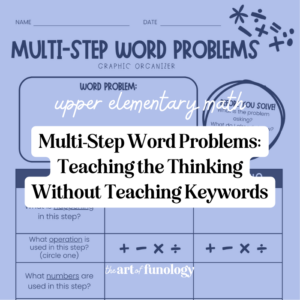
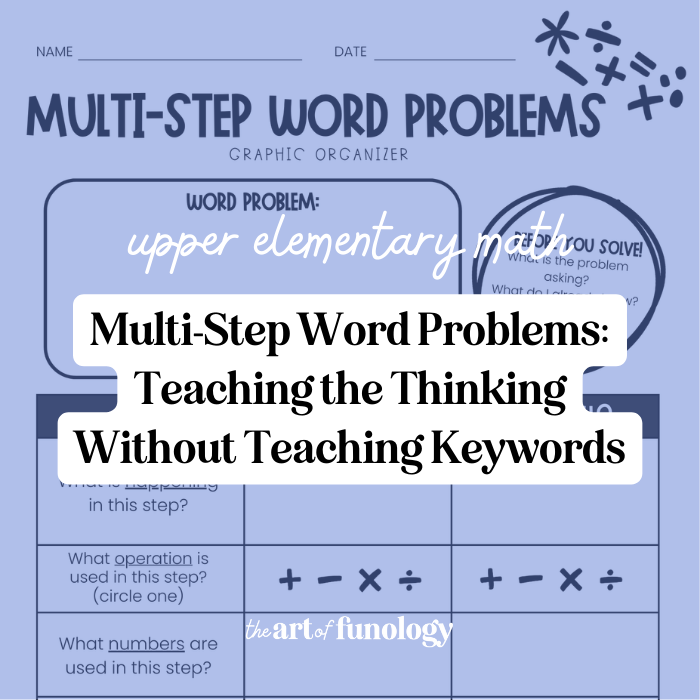
Grab my Multi-Step Word Problem Organizer — it’s visual, flexible, and helps students slow down and make sense before they solve.
Why “Circle the Numbers” Isn’t Cutting It
If you’ve ever watched a student underline “altogether” and immediately write an addition equation—without pausing to think—you’ve seen the damage keyword strategies can do.
For years, the go-to method for teaching multi-step word problems has been this familiar checklist:
🔴 Circle the numbers
🟡 Underline the question
🔵 Box the key words
🟢 Solve
And while those routines might look organized on paper, they’re missing the most important step: thinking.
When we teach students to chase keywords, we’re accidentally training them to:
- Memorize operations instead of making sense of the situation
- Treat “in all” as always meaning addition—even when it doesn’t
- Rush through problems without pausing to visualize or plan
It’s a surface-level strategy that falls apart when the wording gets tricky, the context shifts, or test writers intentionally avoid clue words.
The Real Problem with Keyword-Based Problem Solving
Teaching students to “look for key words” might seem helpful at first. It gives them a strategy. It feels structured. But in reality, it creates fragile understanding.
Here’s what that looks like in the classroom:
- Students add two numbers just because they’re both there
- They subtract when they see “how many more,” even if the question is about total cost
- They skip rereading the question because they think they already know what to do
By the time standardized testing season hits, these same students are frustrated and confused. They’ve learned “the tricks” — but not the thinking.
Keyword Strategies Don’t Teach Reasoning
The phrase “how to teach multi-step word problems without keywords” is more than a blog title — it’s a mindset shift. It’s about guiding students to:
- Visualize the problem instead of grabbing numbers
- Understand the situation before solving
- Plan their strategy based on logic, not vocabulary
If you want long-term success in upper elementary math, especially with multi-step word problems, ditching keyword tricks is the first step toward true problem-solving fluency.
How to Teach Multi-Step Word Problems Without Keywords: Shift the Focus to Thinking
So if keyword-hunting isn’t the answer… what is?
It starts with a mindset shift: What if we treated word problems like puzzles to be solved—not scripts to be followed?
Instead of training students to spot magic words, we teach them to understand the problem itself. That means building habits of reasoning, making connections, and planning strategically.
Step 1: Use a Visual Organizer That Prompts Thinking
Before we ever talk about numbers or operations, I introduce students to a simple graphic organizer. It’s not a worksheet—it’s a thinking tool.
This organizer helps them:
- Summarize what they know from the problem
- Identify what they’re trying to find out
- Break the situation into steps (without relying on clue words)
- Sketch or diagram the relationships involved
- Choose an operation only after they’ve made sense of the context
Why it works: It slows students down just enough to encourage reasoning. Instead of jumping straight into solving, they pause, think, and plan. That’s where the real math happens.
Want to try it? You can grab my free Multi-Step Word Problem Organizer here — it’s simple, visual, and gets students to actually think before they solve.
Step 2: Teach Multi-Step Thinking Out Loud
Once students have the organizer, I model the thinking process in real time.
We read the problem together—but we don’t solve right away. Instead, we talk:
- “What do we know?”
- “What are we trying to figure out?”
- “Does this feel like one step… or more?”
- “If we solve this part first, what does that tell us?”
That discussion is everything. It turns math from a silent struggle into a shared problem-solving journey.
Bonus Tip: Let students explain their approach before solving. This builds confidence and gives you insight into their reasoning.
Step 3: Reinforce with a Low-Stress, High-Impact Practice Activity
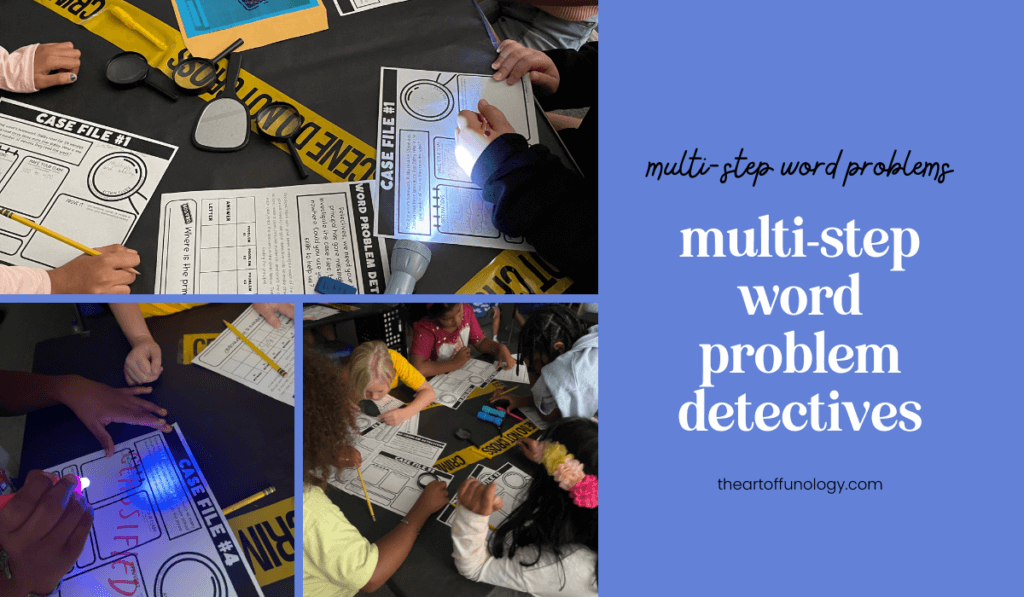
Once students have practiced visualizing, planning, and discussing multi-step word problems, we bring it all together with something fun: Word Problem Detectives.
In this resource, students:
- “Investigate” complex problems using structured clues
- Think like real mathematicians—not robots
- Build a sense of math story, not just steps and numbers
It’s designed to be rigorous but engaging—so students feel challenged without shutting down. Plus, the detective theme adds a bit of novelty (and who doesn’t love a good mystery?).
➡️ Check it out here: Multi-Step Word Problem Detectives on TpT
The Bottom Line?
If you want to know how to teach multi-step word problems without keywords, the answer isn’t more steps—it’s better thinking. Give students the tools to slow down, understand, and reason, and you’ll see problem-solving confidence grow across the board.
Why This Approach to Multi-Step Word Problems Works
Teaching multi-step word problems without relying on keywords creates a lasting shift in student thinking. When students are taught to approach problems thoughtfully rather than procedurally, they build real mathematical understanding—and the results show up quickly.
Students Learn to Slow Down and Make Sense of the Problem
Instead of scanning for numbers or clue words, students are guided to pause and think.
They begin to read for meaning, visualize what’s happening, and plan a path to the solution before jumping in. This habit alone leads to more accurate answers and far less frustration. It builds the kind of math reasoning that test prep strategies alone can’t deliver.
With the visual organizer in hand, students develop a routine of asking, “What is this problem really asking me to do?”—a critical shift for long-term success in upper elementary math.
Deeper Understanding Replaces Memorized Tricks
When students are no longer relying on shortcuts like “in all = add,” they’re free to analyze the relationships within the problem. They start to ask themselves:
- What’s happening in this situation?
- Which part should I solve first, and why?
- How do these quantities relate to each other?
This is the foundation of conceptual math thinking. You’ll see students begin to explain their reasoning with confidence—because they actually understand the structure of the problem, not just how to “solve it.”
Students See How Multi-Step Problems Build One Step at a Time
One of the most important shifts in this approach is helping students recognize how one step leads to the next. When you teach multi-step word problems as a chain of connected ideas, students can track their thinking more clearly.
Instead of guessing or jumping to operations, they begin to map out a plan:
- Solve the first part
- Use that result to unlock the next
- Think about what the story tells them—not just the numbers
Over time, they stop dreading these problems and start seeing them as manageable.
You Get a Clearer Window Into Student Thinking
From a teacher’s perspective, this strategy also improves your ability to assess what students truly know.
Whether it’s through their written organizer or how they explain their process during the Word Problem Detectives activity, their thinking becomes visible. You’ll be able to quickly pinpoint:
- Where a misconception is forming
- Which students are rushing or skipping steps
- Who is building genuine independence
Rather than wondering whether students “get it,” you’ll have evidence—both in their work and in how they talk about it.
What Teachers Are Saying
“My students were instantly engaged with the different manila envelope case files! The word problems themselves were fairly tricky however for my students to work on independently at centers. But as a whole, this resource is a fun way of getting students to work with multi-step word problems!”
— Kaylin A.
“This was a GREAT resource to use for practicing word problems! Students loved the different approach and made solving the problems more engaging!”
— Carla R.
Want Students to Tackle Word Problems with Confidence?
If your students freeze up at the phrase “multi-step word problem,” it’s time to change the narrative. The Word Problem Detectives resource turns problem-solving into a puzzle students want to figure out.
With case files, visual supports, and realistic scenarios, this activity helps students engage with multi-step problems by thinking logically—not hunting for keywords.

👉 Grab the full Word Problem Detectives resource here
Try the Strategy Free
Not ready to dive into the full activity yet?
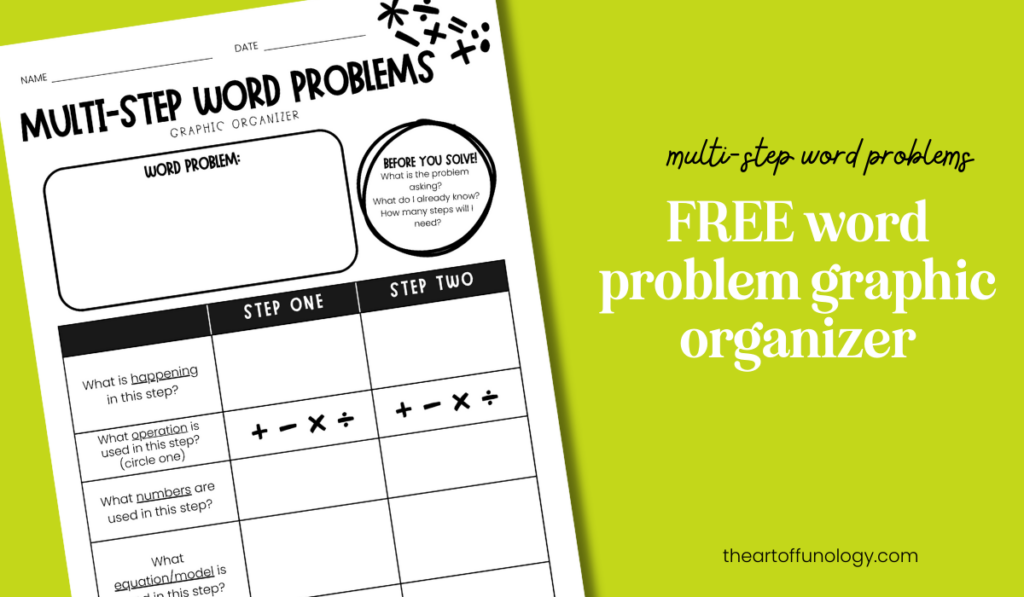
Start small with the Multi-Step Word Problem Organizer—a visual tool that guides students to slow down, understand the problem, and make a plan before solving.
Final Thoughts: Teach the Thinking, Not Just the Steps
The problem isn’t that students can’t solve multi-step word problems—it’s that they’ve been taught to follow, not think.
When we shift our focus from keywords and “tricks” to thoughtful reasoning, we empower students to approach each problem with curiosity and confidence. Teaching multi-step word problems without keywords doesn’t mean removing support—it means giving students the right support: visual organizers, discussion, modeling, and tools that guide thinking, not guessing.
Whether you’re prepping for state testing or trying to build math thinkers in your everyday lessons, this approach helps students slow down, make sense of each part, and discover that problem-solving is a skill they can actually enjoy.
Keep Reading:
If you liked this post, you might also enjoy: